T018 // Everyone Needs Space Weather Forecast
Plus Combating climate change from space, satellites destroyed by the Sun, the latest developments in space governance, regulations & policy, and psychedelic images of pilots in a bathtub
 FIG. 01 · T018 COVERREC ●TRANSMISSION T018
#LAUNCHPADIn today’s edition
G’day Trailblazers!
We’re Trailblazers, the Space Newsletter that helps you plan your interstellar commute without the fear of solar flares or geomagnetic storms. Stay curious, stay prepared, and keep your eyes on the skies—it's a wild universe out there!
- #STARGRAPHWhy Everyone Needs Space Weather Forecast
- #STARGRAPHProfessional Users of Space Weather Data
- #PRODUCTIVITY5 Resources to Boost Your Workflows
- #SPACEREGSDevelopments in space governance, regulations & policy
- #INTHELOOPTech Trends on Earth Shaping Our Future in Space
- #GHOSTINTHEMACHINEOil Painted Pilots in a Bathtub
#TOGETHERWITHManage Any Space Project, Your Way
 SPONSOR TRANSMISSION · monday.com
Sponsored · monday.com
Elevate your space projects with monday.com! 🚀
Archived sponsor message from 25 APR 2024.
#NEWSSpace Economy Bites & Snaps
Space & Climate Change
Satellites play a crucial role in combating climate change by providing essential data for environmental monitoring, which aids in shaping effective policy-making efforts.
Emerging Markets
The space economy's expansion into non-Western regions underscores significant, untapped opportunities for global investors and innovators alike.
- SNAP · 01NGSO: New report details how next-gen satellites are reshaping the high-throughput markets.
- SNAP · 02Space Fund: Japan announces 1-trillion-yen initiative to amplify its space business sector.
- SNAP · 03Free Thrust: Former NASA engineer develops revolutionary propellant-free thruster, could change space travel.
- SNAP · 04Ground Stations: mu Space and RBC Signals partner to enhance ground station facilities in Southeast Asia.
- SNAP · 05Wireless Power: U.K. startup Space Solar's test shows promise for renewable energy advancements.
#REALLY?The Sun Knocked 38 Satellites Out of the Sky. Yep!
When space weather turns rough, even state-of-the-art satellites are no match.
 Higher orbit thin air, unaffectedSolar storm heats the upper atmosphereAtmosphere swells denser air, higher upNew satellites still in a low orbitRe-entry drag pulls them down
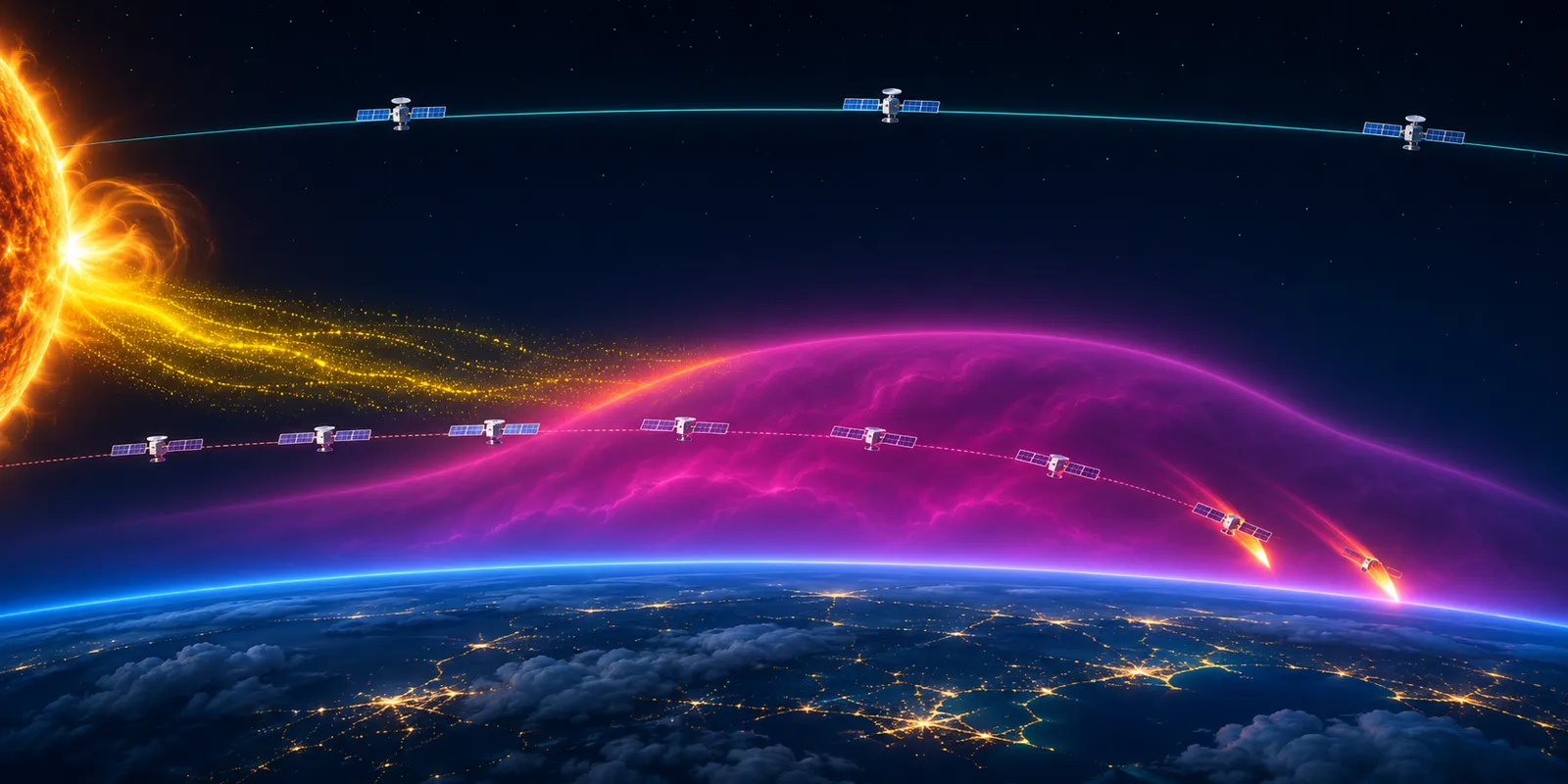
In February 2022, SpaceX launched 49 Starlink satellites into a low orbit. A geomagnetic storm hit soon after. It heated the upper atmosphere and made it denser, which increased drag on the new satellites. 38 of them fell back to Earth and burned up on re-entry.
So if you think space weather is distant and fanciful, remember those 38 satellites. A solar storm can cause real losses in hours. That is why space-weather forecasts matter to anyone launching or operating satellites.
#MARKETWATCHInvesting in the Universe
| FUND | PRICE | CHANGE |
|---|---|---|
| Procure Space ETF (UFO) | $15.47 | ▼ -0.2% |
| RK Space Exploration and Innovation (ARKX) | $14.44 | ▲ 0.0% |
| S&P Kensho Final Frontiers (ROKT) | $42.75 | ▲ +1.1% |
#BEYONDTHEHYPEThoughts and Opinions
Everyone Needs Space Weather Forecast
01What is it?
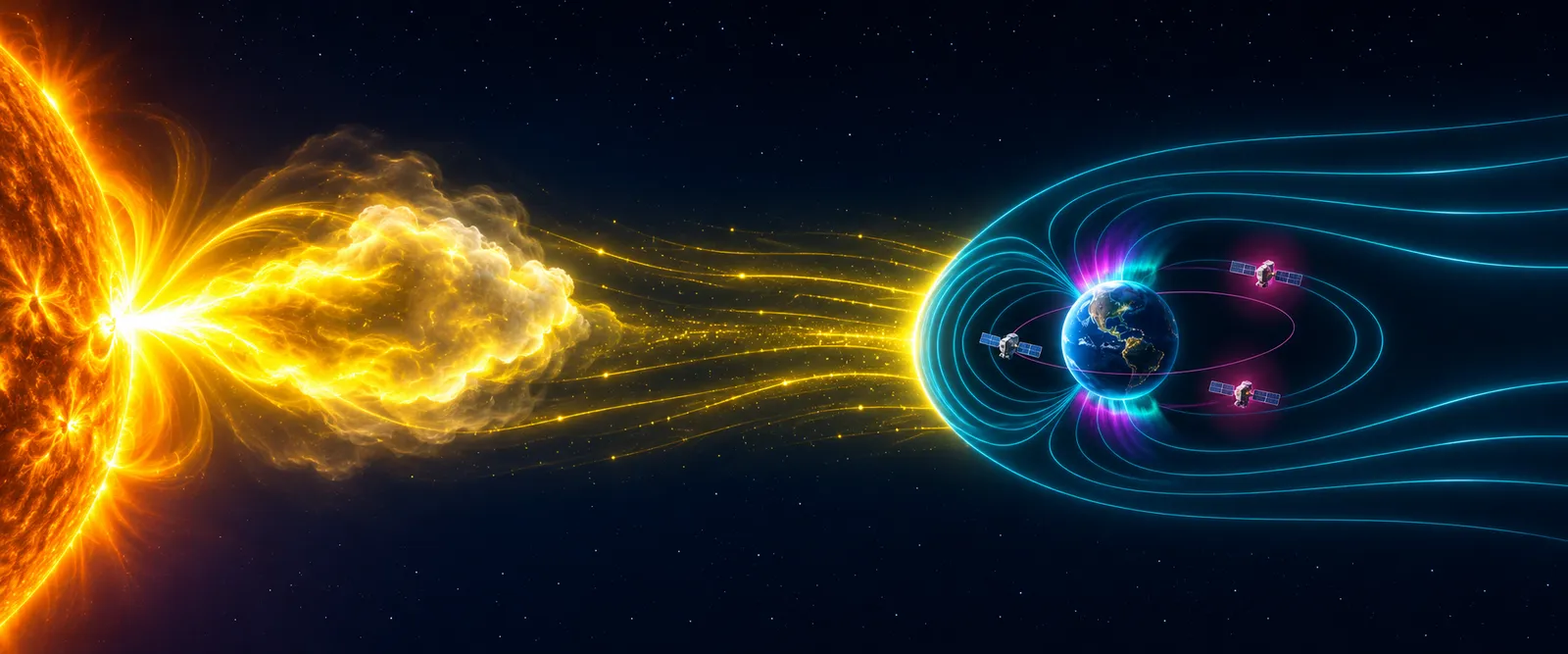
Space weather can be described as the mood swings of the Sun. The Sun constantly emits streams of tiny, charged particles that form the solar wind. When it becomes particularly active, the Sun produces powerful flares that send even more energy and particles into space. These solar winds and flares reach our planet and interact with its magnetic field, causing auroras to appear in the sky. But besides creating marvelous visual effects, solar storms can harm space and ground-based infrastructure. These storms can disrupt satellites, cause blackouts and radio communication failures, as well as increase radiation levels, which can be dangerous for astronauts and high-altitude air travel.
02Why is it important?
As technology advances, we become increasingly dependent on satellites, as they play a crucial role in all aspects of our daily lives, from internet and cellular connection to navigation and weather forecasts. If space weather disrupts their operation, it will lead to all sorts of failures in essential daily services. For instance, we may temporarily lose access to bank accounts and online services required for remote work. On top of that, emergency and security systems could also be compromised, since their rapid response relies on satellite communications and navigation systems. If a powerful geomagnetic storm happens today, it could cost the global economy €38.4 billion in a single day.
At the moment, there are approximately 8 thousand active satellites in Earth’s orbit, and this number is expected to grow to 25 thousand by 2031. As the number of satellites increases, so does their vulnerability to space weather, because operators are unable to manually control this many satellites and quickly react to solar activity. Therefore, it is necessary to develop automated systems that can send warnings and adjust satellite orbits to minimize the risk. Over the past 5 years, the world has lost around $950 million worth of satellites due to solar storms and other space phenomena. Such losses are likely to increase in the future, which makes protection from space weather an essential issue for the entire world.
03Challenges and solutions
Solar activity goes through cycles that last about 11 years, during which it can increase or decrease. We are currently in the middle of Solar Cycle 25 which will reach its peak in 2024-2025. During this period, the number of solar flares and storms will see a dramatic increase, meaning that the risk of failures in critical Earth infrastructure will increase as well. However, powerful storms can even happen during the period of solar minimum, which makes it all the more important to take several measures to ensure global technological safety:
Reinforcing space weather monitoring. Solar activity monitoring requires a reliable network of satellites distributed throughout the orbit to maintain continuous and comprehensive observation. Companies such as Mission Space are working on developing compact satellites to expand the observation network and help gather and organize systematic data for accurate space weather forecasts.
Creating a universal data lake. A centralized repository of data on space weather will compile information about solar activity from various sources around the world: satellites, observatories, space agencies, research centers, and more. This integration will allow us to eliminate data fragmentation, increase the accuracy of forecasts, and provide a holistic view of the most important aspects of space weather.
Using machine learning. Machine learning algorithms can automatically analyze large amounts of data, identify patterns, and predict potential space weather events. This technology can greatly improve the speed and efficiency of data analysis.
Promoting international cooperation. Unlike Earth weather, space weather affects the planet as a whole. To monitor and predict space events efficiently, it is essential to use data from the entire world, which is only possible with international cooperation. The exchange of information and resources enhances the accuracy and speed of forecasting, making it possible to prepare for space weather challenges in advance.
#TOGETHERWITHTake your space career from if, to when, to how
 SPONSOR TRANSMISSION · COURSERA
Sponsored · COURSERA
Reach your space career goals with Coursera Plus
Archived sponsor message from 25 APR 2024.
#STARGRAPHProfessional Users of Space Weather Data
 Flare + CME a cloud of charged particlesSolar wind streams towards EarthMagnetic field squashed on the Sun sideAuroraSatellites exposed
#PRODUCTIVITY5 Resources to Boost Your Workflows
- TOOL · 01Tensorflow → TensorFlow makes it easy to create ML models that can run in any environment.
- TOOL · 02Mission SpacePROMOTED → - Space Weather Decision Support System 🎫 → Access a cloud service that helps businesses on Earth and in space mitigate space weather impacts. Features APIs for detecting, predicting, and warning about solar storms and space radiation risks.
- TOOL · 03Monday.comPROMOTED → A collaboration platform that allows teams to focus on executing tasks, projects, and processes efficiently and achieve shared goals at scale.
- TOOL · 04Rocket Science 101 SpecializationPROMOTED → Explore modern & historic innovations in rocketry. Gain expertise in global rocketry history, orbits, rocket engines, and the benefits of space exploration.
- TOOL · 05Introduction to the Orbital PerspectivePROMOTED → Taught by astronaut Ron Garan, this course uses his ISS experiences to enhance teamwork and global awareness and involves students in projects addressing Earth's challenges.
#SPACEREGSDevelopments in space governance, regulations & policy
Space Safety
The U.S. FAA is updating its licensing regulations to require all spacecraft designed for reentry to obtain a reentry license before launch, aiming to enhance public safety and operational integrity. This move, motivated by past incidents of unlicensed reentries, marks a critical step in tightening safety measures as commercial space activities increase.
UN & Space Weapons
Russia's recent veto of a UN Security Council resolution aimed at preventing the deployment of nuclear weapons in space has sparked international concern. This veto challenges efforts to affirm the Outer Space Treaty's ban on such armaments, raising tensions about space militarization and global security. The resolution, supported broadly except by Russia and abstained by China, signifies a contentious divide in international space law enforcement.
Net Neutrality
The FCC is poised to vote on reinstating net neutrality rules, reflecting a critical shift back to enhanced oversight of internet service providers. This anticipated decision underscores a broader debate about open internet access and the balance between regulation and innovation, amidst evolving political and technological landscapes.
Space Peace
China has reiterated its commitment to the peaceful use of space, emphasizing the strategic role of its Aerospace Force in promoting safety and transparency in space operations. This declaration underscores China's aim to collaborate internationally, enhancing dialogues and cooperation to ensure the security of space as a global commons. A significant reaffirmation of peaceful exploration intentions amid global space race dynamics.
US Moon
Sweden, Switzerland, and Slovenia have joined the Artemis Accords, signaling their commitment to cooperative and responsible lunar exploration alongside 36 other nations. This expansion reflects the broadening international support for NASA's Artemis program, emphasizing a collective effort to return humans to the Moon. A notable moment of unity in space exploration, contrasting with alternative partnerships like the China-Russia led International Lunar Research Station.
Chinese Moon
Thailand has joined the International Lunar Research Station (ILRS), led by China, marking a significant step in its space ambitions. This move raises questions about the geopolitical implications of space alliances, especially in the context of growing space cooperation between ASEAN countries and major space powers. Thailand's commitment could influence regional dynamics and reshape its role in global space politics, highlighting the strategic importance of space collaboration.
EU Space Law Delays
The European Commission is postponing a key space law and a contract for a satellite constellation until after the summer, aligning these initiatives with the broader legislative schedule affected by upcoming parliamentary elections. This delay reflects the complex interplay of policy development and electoral politics, potentially impacting the strategic direction of Europe's space activities. A critical time for shaping the future regulatory landscape of the European space market.
Noncompete Ban
The U.S. FTC has officially banned noncompete agreements, deeming them an unfair method of competition that restricts workers' freedoms and stifles innovation. Most existing noncompetes will be voided, except for senior executives. This landmark decision is expected to boost job mobility and foster entrepreneurship, positively impacting wages and the broader economy, including space.
Commercial Space Value
The U.S. Space Force is urging the commercial space industry to demonstrate the practical value of emerging services like in-orbit refueling. This challenge is part of a broader strategy to integrate private sector innovations into military operations, ensuring these new technologies offer clear benefits and fit within a viable business model before full adoption.
#TOGETHERWITHLooking for visuals and charts, rather than words, to understand the daily news?
Sponsored
Bay Area Times is a visual-based newsletter on business and tech, with 250,000+ subscribers.
Archived sponsor message from 25 APR 2024.
#INTHELOOPTech Trends on Earth Shaping Our Future in Space
Renewable Pioneers
Despite nearly 100% renewable energy, Costa Rica faces challenges from climate change and grid variability, pushing for more diverse energy sources.
Levitation Breakthrough
New advancements in room-temperature superconductors show strong full levitation effects, promising future tech innovations.
Solar Surplus
California's solar boom leads to negative electricity prices by day, highlighting challenges and opportunities in energy management.
Neuromorphic AI
Intel's new brain-inspired system, Hala Point, achieves unprecedented computational power and efficiency, marking a significant advance in AI technology.
Tech Tension
China mandates removal of Intel and AMD chips from telecom networks by 2027, intensifying the global chip rivalry.
#GHOSTINTHEMACHINEOil Painted Pilots in a Bathtub
 01
 02
 03
 04
EOFUntil Next Time
#MISSIONDEBRIEFGetting Better Together
I value your opinion, so if you have specific advice or anything interesting you’d like to share, please let me know on LinkedIn.
Thank you for reading and see you at the next orbit!
P.S. New here? Get the next issue in your inbox: [ subscribe --free ]